

Reviving All Souls Day … Should We Pray for Dinosaurs?
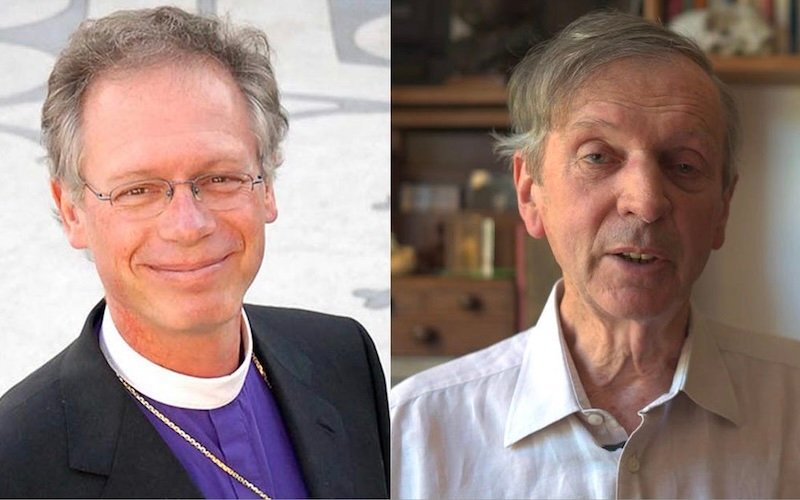
Rupert Sheldrake talks with Marc Andrus, former Episcopal Bishop of California
Grace Cathedral, San Francisco, September 2015.
Marc Andrus: Rupert, thank you for this conversation. It’s always more than a delight to be in conversation with you. It supports life and supports me. I love it. We’re talking a little about the Feast of All Souls Day, which follows All Saints Day. So All Saints Day is November the 1st and All Souls Day, November the 2nd.
And I have an interest in that. I’m studying All Souls Day because of the particular content of All Souls Day as being a day when we pray for the dead and when we ask the dead to pray for us. And this idea of being able to communicate through prayer with those who have died is fascinating to me. It’s not just intellectually fascinating. I think we need it.
I spoke with Rowan Williams not long ago about this topic. I told him I was studying it and researching it. And I said that I had had an elderly English friend, a woman who had been from a horse racing family and a very holy, wise person. And she told me it was her favorite feast in the Christian calendar all year other than Christmas. And that was a surprise to me because I didn’t know that All Souls Day had much power in England. And so I asked Rowan about it. I said, is it well-loved and celebrated and do people care about it? And he said, they really do. They didn’t until World War I. And then everyone lost someone. And the idea of being able to communicate with them through prayer became deeply meaningful to people.
And then I asked him the follow-up question: well, what about the dead praying for us? And he said, well, that is less obvious to people. The desire to communicate with them prayerfully is first. But when you open the subject for people, they say, “Yes, I’d like Granny to pray for me, as well as the great saints like Francis or Mary Magdalene or our guardian angels. But I’d like Granny to pray for me as well.” So that’s the topic.
And it raises all kinds of really interesting questions that are in your research area, I think. How is this possible? And are we talking about only individuals, that is, the dead individual? Are we talking about the communion of saints and the communion of all those faithful who have died? It’s more of that. And so then we’re talking about a kind of collective and yet individuated consciousness that encircles the globe or permeates the globe or maybe permeates the cosmos. And we are communicating with it. And again, there’s the plural: we are communicating with it. So I have a prayer, but there are many, many people praying. So you could actually conceive of a kind of luminous globe of prayer that is passing back and forth between the dead and the living.
And so several things come to mind when I think of that prayer. Teilhard de Chardin spoke of the noosphere as encircling and encasing the earth with a consciousness. Might we think of that noosphere as being composed of all those faithful who have lived, all those who have lived, and their concern for the planet and their concern for the living? And might we also add our consciousness through prayer to them? So those are some of those things.
Then the real nub of it is prayer itself. So morphic resonance, such an important concept. It’s transformative. Your work is completely transformative. And the fields… there are some researchers, and you write about it in The Presence of the Past , who really concentrate on intention. When we enter in the realm of intention, it’s a short step to prayer. But until you add intention to the picture of morphic fields and the resonance of them, it’s a sort of automatic process. One could think it just happens and there’s no personhood there and there’s no intention there.
So the topics that I’m interested in are prayer between the dead and the living, back and forth. And then how would we conceive or maybe even picture this relationship? Is it individual or is it this kind of collective consciousness? Is it individuated collective consciousness? And then what about the role of prayer in this relationship? What is prayer? What’s its effect? And how would science understand prayer? It’s really been in the realm of theology and religious practice almost entirely. And it’s time for those two areas to speak a little to each other, it seems to me.
Rupert: There’s lots of questions, lots of issues. Well, you’re right, morphic resonance is primarily about habits, which can be unconscious. The more habitual something is, the more unconscious it is. And prayer is clearly not about being unconscious. It’s about forming intentions. Not just intentions, but intentions within the context of a larger consciousness, larger than our own. If you have intentions just within the context of your own consciousness, then it could be called the power of positive thinking. You know, there’s a huge literature in America especially on positive thinking: how to sell encyclopedias more effectively through positive thinking, how to get parking places by positive thinking, and so on. That’s like intention without prayer.
Marc: Yes.
Rupert: That intention alone, many people believe, is sufficient to help encourage things to happen.
Marc: Indeed.
Rupert: But intentions can have effects at a distance. And we know this from actual research. My own research, for example, on Dogs That Know When Their Owners Are Coming Home, shows that many dogs can pick up people’s intention to go home and start waiting at the door or the window when the person’s on the way. And it’s a kind of telepathic connection. Now, that’s not exactly a prayer, but it shows that by intending something, there can be an effect at a distance.
And I think in prayer, if we intend something, say you’re praying for somebody who’s sick, even if they’re miles away and they don’t know you’re praying for them, your intention reaches out to that person, just like it reaches out to home if you’re going home, and forms a connection with that person…